After years of promising laboratory results and distant timelines, the electric vehicle (EV) industry is finally on the cusp of a technological revolution. Industry analysts and automakers are signaling that 2026 will be a pivotal year for semi-solid-state batteries, with the technology moving from pilot lines to public roads. While fully solid-state batteries remain a few years away, their hybrid counterparts are set to deliver dramatic improvements in range and safety starting this year .
A New Standard for a New Era
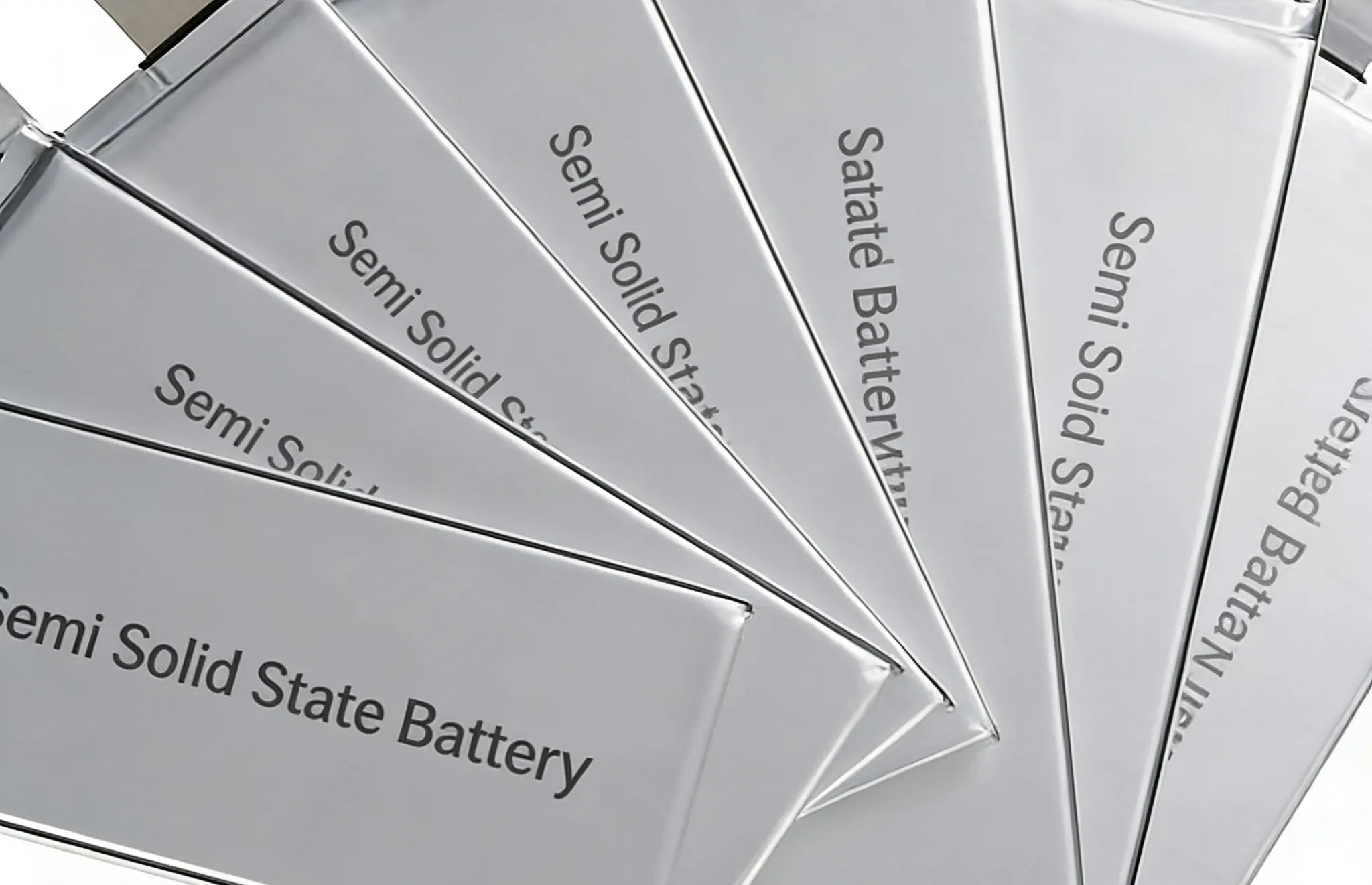
In a move to bring clarity to the rapidly evolving sector, China has introduced the world’s first national standard for solid-state batteries, officially taking effect in July 2026. The standard provides a strict classification system based on electrolyte content, formally defining batteries with 5-10 percent liquid electrolyte as “hybrid solid-liquid batteries”—the technology previously marketed as semi-solid-state .
This regulatory framework is expected to eliminate marketing ambiguity and establish a unified benchmark for safety and performance, giving manufacturers a clear target for development .
Record-Breaking Range and Energy Density
The performance claims coming from automakers in 2026 are staggering, suggesting the end of “range anxiety” may finally be in sight.
FAW, the Chinese automaker and partner of Volkswagen, has begun testing prototype vehicles equipped with a semi-solid-state battery pack developed with Nankai University. The cells boast an energy density exceeding 500 Wh/kg—roughly double that of conventional lithium-iron-phosphate (LFP) batteries. The 142 kWh pack currently delivers over 1,000 kilometers of range, with FAW stating that iterative upgrades could push pack capacity beyond 200 kWh, enabling a range of more than 1,600 kilometers .
A key innovation in the FAW battery is the replacement of expensive nickel with manganese in the cathode. This lithium-manganese-rich design offers a specific capacity of over 300 mAh/g while significantly lowering material costs .
Changan Automobile is also aggressively pursuing the technology. The company confirmed it will begin trial installations of its “Golden Bell” solid-state packs in EVs and robots before the third quarter of 2026, with mass production slated for 2027. Changan claims its all-solid-state version achieves 400 Wh/kg, powering a vehicle for over 1,500 kilometers on a single charge .
The Hybrid Advantage: Speed to Market
While “true” solid-state batteries face steep manufacturing hurdles, hybrid solid-liquid batteries offer a pragmatic bridge. By combining a solid electrolyte for safety with a small amount of liquid to maintain conductivity, these batteries can be integrated into existing production lines with minimal retooling. According to experts, adapting current lines for hybrid production costs only 30 to 40 percent of what it would take to build a new facility for full solid-state manufacturing .
This manufacturing synergy is accelerating deployment. SAIC Motor’s MG brand has already started delivering the MG4 hatchback equipped with a hybrid solid-liquid battery, marking what the company calls the world’s first mass-produced vehicle of its kind .
Svolt Energy is ramping up a 2.3 GWh production line dedicated to its first-generation semi-solid-state cells (270 Wh/kg) and has secured orders from overseas luxury brands. The company plans volume deliveries later this year .
Dongfeng Motor expects to begin mass production of vehicles with 350 Wh/kg solid-state batteries by September 2026, enabling a 1,000 km range .
Nio is set to adopt 360 Wh/kg hybrid solid-liquid batteries for its ET9 sedan in the second quarter of 2026, which will remain compatible with its extensive battery-swapping network .
A Dose of Reality: Challenges Remain
Despite the rapid progress and flashy range estimates, industry experts urge caution. The distinction between pilot production and stable, high-volume vehicle application remains vast. Fine-tuned processes and strict automotive validation are required to ensure safety and longevity .
Cost is another significant bottleneck. A report from Huayuan Securities indicates that sulfide-based solid-state batteries currently cost approximately $158.8 per kilowatt-hour, compared to $118.7/kWh for traditional lithium-ion batteries. Lower yield rates in production further exacerbate these costs .
Furthermore, the technical pathway to full solid-state is not yet settled. The industry is divided among polymer, oxide, and sulfide electrolyte approaches, each with trade-offs between conductivity, stability, and safety .
The Skeptics and the Hype Cycle
The fervor around solid-state technology has also attracted skepticism. When Finnish startup Donut Lab claimed at CES 2026 that it was producing true solid-state batteries with 400 Wh/kg, a 100,000-cycle lifespan, and 5-minute charging, industry leaders pushed back sharply.
Yang Hongxin, chairman and CEO of Svolt Energy, publicly dismissed the claims, stating, “That battery doesn’t exist in the world. Any technician with basic knowledge would recognize it as a scam.” He pointed to the contradictory nature of the performance parameters as a red flag .
The Road Ahead
Looking forward, analysts at CITIC Securities project that by 2030, global demand for solid-state and hybrid solid-liquid batteries will exceed 700 GWh, with fully solid-state versions accounting for 200 GWh . McKinsey forecasts around 30 percent annual growth for the solid-state market over the next decade .
For now, 2026 stands as the year the rubber meets the road. With hybrid solid-liquid batteries leading the charge in the premium EV segment and full solid-state versions expected to scale after 2028, the next few years promise to reshape the automotive landscape. As Hu Song, a senior expert at the China Automotive Technology and Research Center, warned, rushing to market without sufficient preparation could lead to setbacks—but the direction of travel is unmistakable . The batteries of the future are arriving today.