For years, sodium-ion batteries were the perennial bridesmaid of the energy world—a promising technology perpetually “five years away” from commercial relevance. In 2026, that wait is finally over. This year has become the pivotal moment for sodium-ion technology, with mass-produced vehicles hitting the roads, grid-scale projects breaking ground, and industry giants declaring that the “dual-star” era of lithium and sodium co-existing has officially begun .
Driven by a combination of volatile lithium prices, geopolitical supply chain concerns, and the relentless demand for cheaper, safer energy storage, sodium-ion batteries are emerging from the shadow of their lithium-ion cousins. With an energy density now sufficient for hundreds of thousands of applications and a cold-weather performance that leaves traditional batteries in the dust, 2026 is the year sodium steps into the spotlight.
Cold Weather Kryptonite: Sodium’s Killer App
The most immediate and tangible victory for sodium-ion technology in 2026 is its domination of the cold-climate segment. While standard lithium iron phosphate (LFP) batteries struggle in freezing temperatures—often losing over 30% of their capacity—the latest generation of sodium-ion cells is thriving in the deep freeze .
In a dramatic display of this capability, a长安 (Changan) automobile equipped with a sodium-ion battery was recently seen navigating the icy terrain of Yakeshi in Inner Mongolia at temperatures as low as -30°C . This is not a lab stunt; it is a demonstration of a real-world breakthrough.
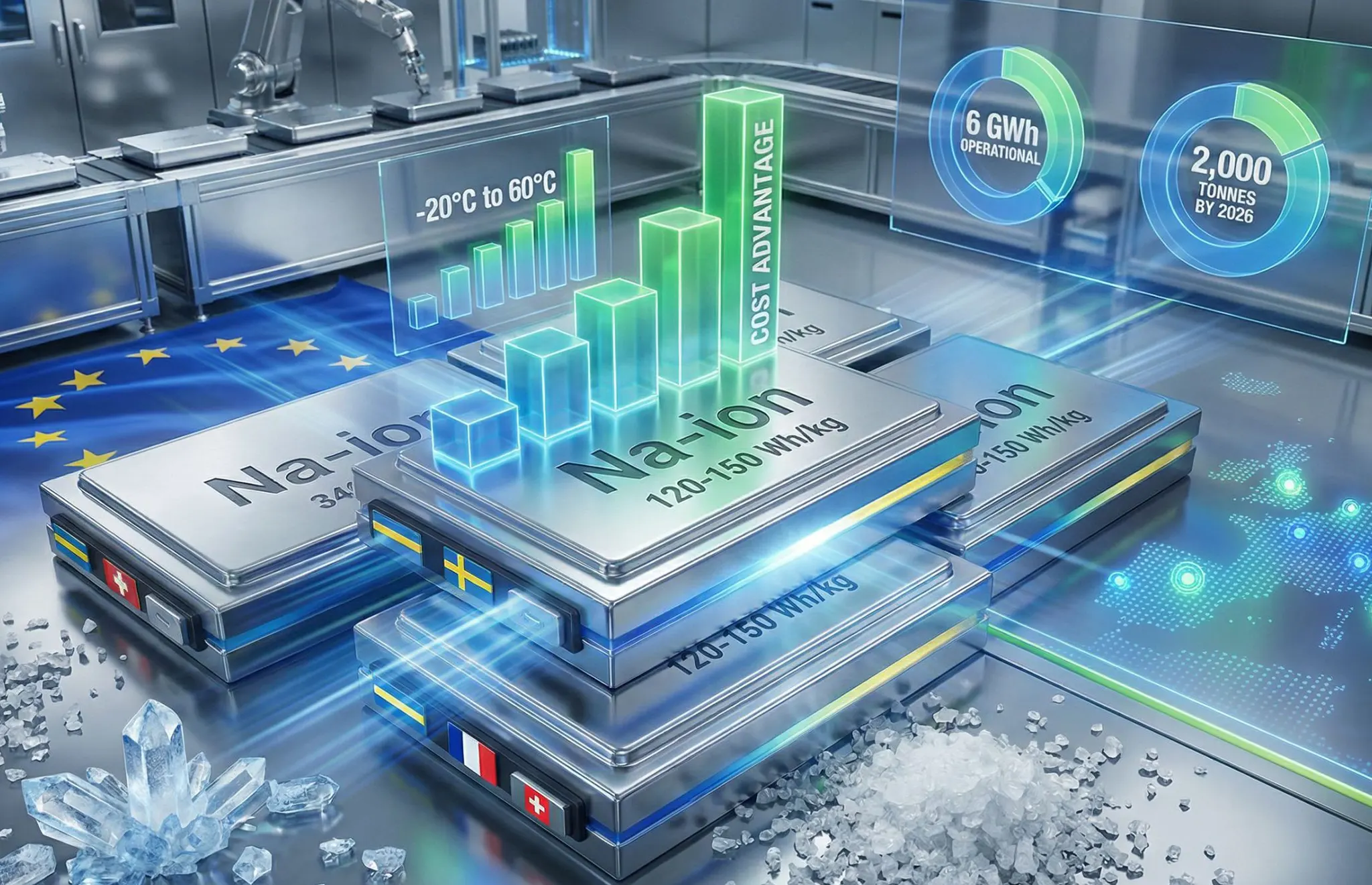
CATL, the world’s largest battery manufacturer, has launched its “Naxtra” series sodium-ion batteries, specifically targeting the light commercial vehicle market. The company’s 45 kWh sodium battery pack is being marketed as a solution for “extreme cold,” with verified performance data showing that it retains over 90% of its usable capacity at -40°C and remains functional for charging at -30°C . By comparison, a standard LFP battery would be virtually immobilized under such conditions.
This low-temperature resilience is fundamentally changing the economics of electric mobility in northern regions. Changan, in partnership with CATL, has unveiled what it calls the world’s first mass-production passenger EV powered by sodium-ion batteries, set for market release by mid-2026. The vehicle delivers over 400 km of range and, in -30°C conditions, provides nearly three times the discharge power of an equivalent LFP vehicle .
The Economics of Abundance
The catalyst for sodium’s 2026 surge is not just technical, but economic. As of early 2026, lithium carbonate prices have more than doubled from their 2024 lows, climbing past the critical ¥150,000 per ton mark and pushing battery manufacturers to seek alternatives .
Sodium offers a compelling hedge. It is 500 times more abundant in the Earth’s crust than lithium, can be extracted from seawater, and its supply chain is geographically diversified . Currently, the cost of sodium is roughly 30 times lower than that of lithium . While sodium-ion batteries are not yet significantly cheaper than LFP at the cell level—primarily due to the youth of the supply chain—analysts project that as production scales, sodium-ion packs could ultimately be 30% to 40% cheaper than their lithium counterparts .
This cost trajectory is attracting massive investment. BYD began construction of a dedicated sodium-ion plant in early 2024, and CATL confirmed in January that 2026 would mark the year of “large-scale adoption” for the technology across passenger cars, commercial fleets, and energy storage . The market research firm QY Research estimates the global sodium-based batteries market will grow from $3.45 billion in 2025 to $5.68 billion by 2032 .
Beyond the Car: Grid Storage and Two-Wheelers
While passenger EVs grab headlines, the most profound impact of sodium-ion technology in 2026 may be felt on the electrical grid and in the micro-mobility sector.
In the United States, startup Peak Energy has partnered with Energy Vault to develop a dedicated energy storage solution for the volatile power demands of AI data centers. The companies have signed a 1.5 GWh supply agreement for U.S.-manufactured sodium-ion batteries, designed to offer higher safety and lower cooling requirements than traditional lithium-ion systems . Because sodium-ion cells can be safely transported and stored at zero volts, they offer significant safety advantages for large-scale stationary installations .
Meanwhile, in China, the micro-mobility revolution is going sodium-powered. The scooter giant Yadea launched four models of two-wheelers using sodium-ion batteries in 2025, and cities like Shenzhen are piloting battery-swapping stations specifically for sodium packs to support the massive fleet of delivery drivers and commuters . For applications where energy density is less critical than cycle life and cost, sodium is proving to be the perfect fit.
The Technical Hurdles: Energy Density and Supply Chains
Despite the rapid progress, sodium-ion technology still faces significant headwinds. The primary limitation remains energy density. While CATL’s latest sodium cells achieve up to 175 Wh/kg—competitive with entry-level LFP—they still lag behind high-nickel NMC cells which can exceed 255 Wh/kg . This means sodium-powered vehicles are currently best suited for urban commuters and light commercial use rather than long-haul trucking.
Furthermore, while sodium itself is abundant and cheap, the cathodes in current commercial cells still rely on other critical minerals like nickel and manganese, whose processing remains concentrated in China . Nearly all of the world’s existing and announced sodium-ion manufacturing capacity is located in China, raising concerns that the supply chain concentration the industry sought to escape is simply being replicated with a new chemistry .
However, research is accelerating globally to address these issues. German researchers at the Federal Institute for Materials Research and Testing (BAM) recently unveiled a new “core-shell” design for anodes that could dramatically improve initial efficiency, overcoming a key hurdle related to the formation of the protective solid-electrolyte interphase (SEI) layer. Their design achieved 82% initial efficiency, up from 18% in uncoated samples .
The ‘Dual-Star’ Future
The narrative of 2026 is not one of “sodium versus lithium,” but rather “sodium and lithium.” As CATL stated at its December supplier conference, the two chemistries are poised to form a “dual-star” trend .
In this new paradigm, high-nickel lithium batteries will power premium long-range EVs where weight and volume are paramount. LFP will dominate the mid-range market. And sodium-ion will carve out its territory in low-speed electric vehicles, grid-scale storage, industrial backup, and the coldest climates on Earth .
Professor Chen Renjie from the Beijing Institute of Technology predicts that over the next three to five years, sodium-ion technology will continue to close the performance gap with LFP . For now, 2026 stands as the year the industry finally stopped asking “if” sodium-ion batteries would arrive, and started asking “where” they would be deployed next.